BART SMITH OFFICIAL WEBSITE • AUTHOR • YOUTUBER • COOKIE BAKER • COOKBOOK CHEF • FUTURES TRADER


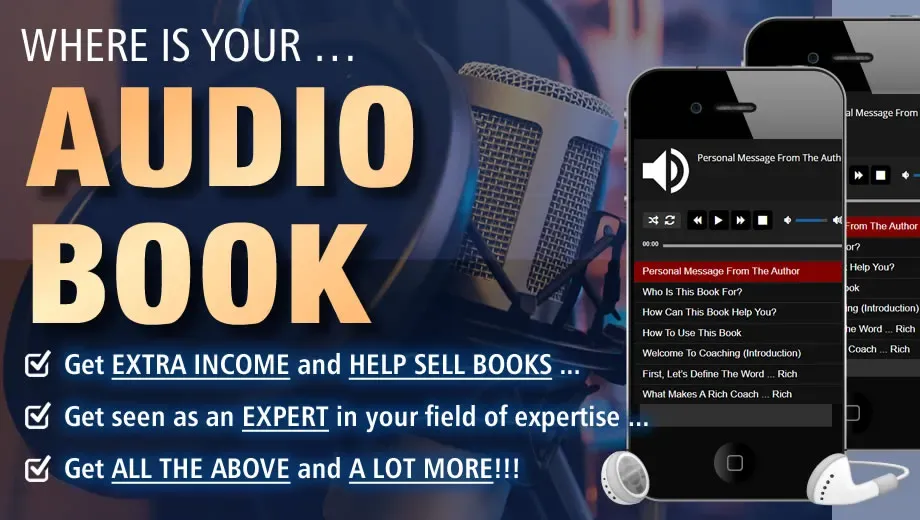
Where Is Your Audiobook?
by Bart Smith
Let’S Talk Audiobooks
With your paperback book and Kindle eBook done, the next question is: Should you create an audiobook? My answer is, “Yes!” But before you record anything, upload anything, or pay for anything, let’s talk “audiobook strategy.” You see, an audiobook is not just your book in audio format for sale. It can become something far more valuable to you and your personal brand than just another product sitting on the proverbial shelf somewhere on Amazon. So, before I show you how I use AI to create audiobooks, let me ask you something really important …
Ask Yourself
What do you actually want your audiobook to do for you? Do you want to sell it as a paid product? Use it to generate leads? Drive traffic to your website? Build your YouTube channel? Attract interviews? Give people a free
way to experience your work? Your answer matters because it can change where you publish your audiobook, how you package it, and how you use it to grow your author platform.
Do not only ask, “How much can I sell my audiobook for?” Ask, “Where can this audiobook create the most exposure, authority, traffic, trust, and opportunity for me to make money beyond mere audiobook sales?” That question changed how I look at audiobooks altogether. Let me explain …
Fork In The Road (Decision Time)
Before you produce your audiobook, decide what job you want it to do. Is it a product for sale? A lead generator? A traffic generator? An authority builder? Your answer determines the path you take.
Your Options
Personally, I looked into the traditional audiobook platform route years ago. For some authors, it may make perfect sense. For me, it did not. Certain technical requirements, the upload process, approval delays, pricing limitations, selling restrictions, discouraging royalty structure, and platform rules did not match the way I wanted to use my audiobooks. I also did not like the idea of hiding my audio behind a subscription-encouraged wall and hoping people would somehow find it. I also didn’t like the idea of audiobook creators getting paid by the minute or hour listened, rather than a lump sum of an audiobook’s total value, and how they were generally part of a royalty share agreement or a streaming usage pool model. Instead of upfront pay, which I wanted, audiobook creators would earn a measly percentage of revenue based on listener engagement, often used in subscription services like Audible Plus or Spotify. I said, “No thanks. I’ll go my own way.” So, I thought BIG PICTURE! I wanted people to hear my books, share them, embed them, subscribe because of them, and discover more of my work without friction. That’s when I went with putting my audiobooks on YouTube for free. In your case, before choosing any audiobook platform, study the current rules, royalties, pricing, distribution options, and restrictions carefully. They can change, and they matter.
The Benefits Of FREE
Audiobook content is evergreen. You upload it once, and it can keep working for you for years. Every full audiobook, chapter track, sample, or playlist can become another doorway into your world. A listener can then become a subscriber, reader, website visitor, coaching client, interview opportunity, speaking invitation, brand deal, affiliate marketer for you or future buyer of other things you might have for sale. Think about it. If your YouTube channel only has a few videos and almost no activity, why would people keep coming back? But if you upload full audiobooks, chapter-by-chapter tracks, samples, playlists, and related book content, your channel becomes a real content library. Instead of chasing people one post at a time, your audiobook can sit there working for you day and night forever. That kind of exposure may be worth more than waiting for the occasional audiobook sale behind a wall. I am not saying you should never sell your audiobook. I am saying you should think bigger than the audiobook sale alone. Maybe you give away part of your audiobook and sell the full version. Maybe you post the whole thing free and use it to build traffic, trust, and authority. Like the old saying goes, “Give away tips, and sell details.” So, I went on my crusade of recording my audiobooks manually and then uploading them to YouTube. That went on for about five years. Then …
AI Changed Everything For Me
For more than 20 years, I recorded the audio for my books myself. Only the past five years have I been uploading them to YouTube. Well, I had the microphone, the software, the editing experience, and enough voice control to sit there for hours and produce professional-sounding audio from home. But let’s be honest. Most authors do not want to do that. They do not have the equipment, the software, the patience, or the desire to sit at a desk for hours reading their own book into a microphone. The old way took hours! Recording an audiobook manually takes a lot of time. You read, stop, stumble, burp, hiccup, cough, sneeze, reread, edit, clean up the audio, remove unwanted breaths, and try not to sound tired halfway through the recording. I could do it because I had years of practice. Most authors just want the finished audiobook without the recording marathon.
The New Way → AI Voice Recording
Today, AI can help you create an audiobook from a short voice sample. Instead of recording your book for five, ten, or more hours, you can record a clean five-minute sample of your voice and use that to generate audiobook narration. I’ve done it, I’ve heard it, and I love it. AI does not get tired! AI does not hiccup. AI does not sneeze. AI does not grow tired or lose its voice. When you give AI a strong voice sample, it can capture enough of your tone, pitch, rhythm, and personality to sound remarkably close to you — maybe even better.
I Put AI Voice Recording To The Test
I tested this with a client who could not sit for hours recording her own audiobooks, even after in-person training. But she could record five minutes. From that short voice sample, I produced three separate audiobooks totaling more than 10 hours of finished audio. She was elated and relieved because she no longer had to sit there for hours trying to record and edit the audio herself. Luckily, I suggested we use AI, and she was off the hook faster than I could say, “They’re all done! Take a listen!”
I Created My Own AI Voice Clone
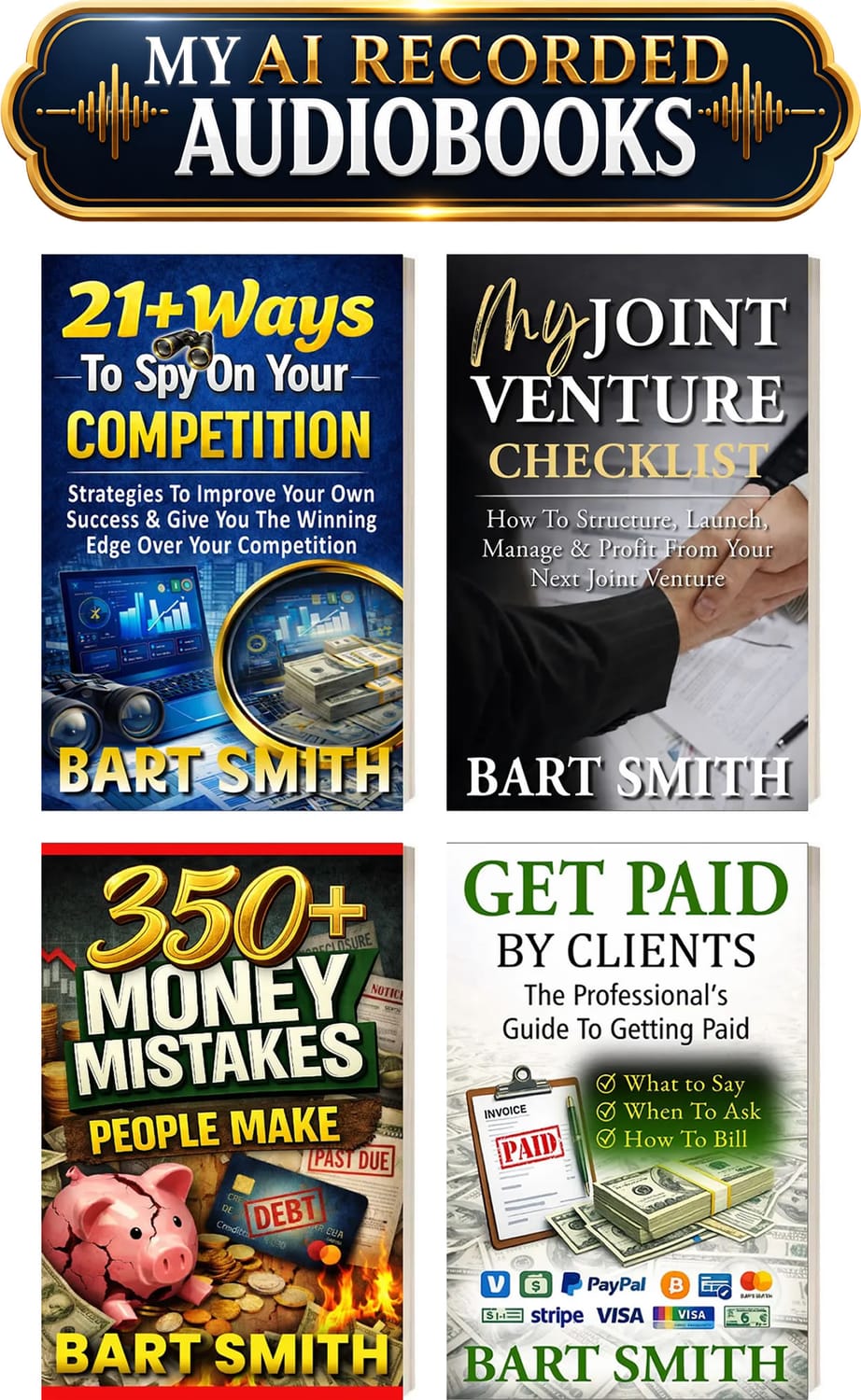
Using samples from my previously recorded audiobooks, I created my own voice clone, from which I generated four audiobooks in one week for 21+ Ways To Spy On Your Competition, My Joint Venture Checklist, 350+ Money Mistakes People Make, and Get Paid By Clients, which can be heard for free on my
YouTube channel at @BartSmithWorld.
That was the turning point for me. Going forward, I’ll never record another audiobook manually from start to finish again. AI saves me time, saves my voice, keeps the audio consistent, and helps me create audiobooks in hours instead of days or weeks. I simply sit at the computer, with my mouth shut, gather the book text I want recorded, guide the AI software track by track, and generate the audiobook section by section.
Sure, you could record your audiobook the oldfashioned
way — manually sitting there for hours on end, recording, stopping, rerecording, editing, and watching the clock tick away. Or, you can let AI help you do the heavy lifting. To do that, here’s how the process works …
Get Ready To Produce Your Audiobook With AI Like I Do
Steps to record your book into an audiobook:
1. Decide Your Audiobook Goal — Are you creating a paid audiobook, a YouTube playlist, a website bonus, a lead generation asset, a course companion, or all of the above? This decision affects how you name your files, create visuals, upload tracks, and promote the finished audiobook.
2. Produce Your Audiobook In Sections Or Tracks — Do not try to generate one giant audiobook file all at once. Break your book into smaller tracks. I like tracks in the five-to fifteen minute range when possible. Shorter tracks are easier to generate, review, fix, export, upload, and organize.
3. Secure Your Final Manuscript — Have your final manuscript in a copy-and-paste available format, such as a Google Doc or Word document. You’ll need to move content into the AI software easily, section by section, so make sure your book text is accessible and ready for track-by-track production.
4. Create Your Audiobook Folder System — On your computer, create a main folder called AUDIOBOOKS. Inside that folder, create one main folder for each audiobook. Then create individual and clearly numbered track folders, such as the following and so on. Clean organization saves headaches later.
5. Record A Clean Voice Sample — Use the best microphone you can. (See BartSmith.com/tech). Record a polished 5-10 minute voice sample with natural energy, variation, emotion, tone, pace, and clarity. Edit out mistakes, background noise, unwanted breaths, and anything distracting. This sample becomes the foundation for your entire audiobook voice clone, so make it as clean as possible.
A QUICK NOTE ABOUT AI VOICE TOOLS & SERVICES → Several AI voice tools you can use to create audiobook narration (i.e., turn your voice into an AI clone). Before choosing one, study the pricing carefully. Some platforms charge by words, characters, credits, minutes, or usage limits, which can get expensive fast if your book is long or you plan to create multiple audiobooks.
Short vs. Long Audiobooks & High Audiobook Production
For one short audiobook, a higher-priced AI voice cloning service, such as ElevenLabs.io or Artlist.io might not hurt the wallet so much. But, for high-volume audiobook production, like I do, you need to be careful. When it comes to any pricing model, READ THE FINE PRINT and what you’re being billed for versus what you’re getting in return.
While many AI voice cloning services produce excellent audio, their pricing plans can drain your wallet fast if they charge by the word, characters, credits, minutes, hours, videos or usage limits. What I NEED is the best combination of voice quality, few to no production limits, ease of use, editing flexibility, production speed, clear file organization, affordable pricing, and subscription flexibility.
So, check the current pricing and features of any AI voice cloning service before you commit. As for me, I like HeyGen.com because it lets me create unlimited videos and audiobook tracks per month, up to 30 minutes per video/audio, has excellent AI voice cloning, a video avatar cloning tool, and its project file organization is fast, clear and simple. Do note, HeyGen is technically a video creation platform, so you would need to download a finished video file (with your audiobook track in it) and extract the audio out if you wanted a separate MP3 file. But, that one extra step is still far easier and faster than manually recording an entire audiobook from scratch.
My Basic AI Audiobook Workflow & Final Thoughts
1. Record or upload a clean 5-10 minute sample of your voice.
2. Create your AI voice clone inside HeyGen.com or similar AI company.
3. Break up your book into audiobook tracks, typically, no longer than 15-20 min. ea.
4. Start, produce, clean and format each script section for a given audiobook track.
5. Add pauses at the start and end of each audio track and wherever else needed.
6. Generate one track at a time. Listen, edit, adjust, and regenerate when needed.
7. Download finished audiobook track and name it to match the folder you save it in.
8. Export the video file and save it on your computer. Extract the MP3 audio if needed.
9. Repeat steps 1-8 for all remaining audiobook tracks until you’re all done.
10. Upload, share, sell, embed, or use the audiobook as a bonus or marketing asset.
Audiobook Sales & Distribution
If you want your audiobook sold through traditional audiobook platforms, research your options carefully. For example, here is a list of audiobook platforms where you could sell your audiobooks to the public:
ACX.com (Audiobook Creation Exchange) — Best for direct dominance on Amazon, Audible, and Apple Books.
AuthorsRepublic.com — Best independent alternative aggregator for wide commercial and library networks. Upload here and they distribute it to multiple platforms for you, including ACX.
FindawayVoices.com (by Spotify) — Best wide-reach aggregator for massive global retail and library distribution.
Kobo.com (Kobo Writing Life) — Best direct-to-retail platform for targeting international book buyers and retail partners.
Other platforms to consider when selling your audiobooks include InAudio.com, IndieAudiobookDeals.com and LanternAudio.com. Look at technical requirements, royalty rates, pricing control, approval times, distribution reach, exclusivity rules, and whether the platform accepts the format you have. That route may work for some authors, but make sure it supports your bigger strategy.
Final Thoughts On AI Audiobooks
While I love that AI is here to help us, AI does not remove our responsibility for quality. You still need to prepare the script, listen carefully, fix what sounds wrong, organize the files, and decide how the finished audiobook will be used. What AI does do is remove the exhausting part of manually recording every word yourself. So, whether you sell your audiobook, give it away, upload it to YouTube, embed it on your website, or use it as a bonus, remember the bigger question: What do you want your audiobook to do for you? Once you know that, choose the workflow that supports that goal and get your audiobook out there. Now that your book is written and published, turned into an eBook, and recorded as an audiobook with AI, it’s time to talk about MARKETING your book, eBook, and audiobook — and MAKING MONEY!
# # #
THE END

Website Design by Bart Smith
© Bart Smith | All Rights Reserved