BART SMITH OFFICIAL WEBSITE • AUTHOR • YOUTUBER • COOKIE BAKER • COOKBOOK CHEF • FUTURES TRADER



BOOK EXCERPT
📖 20 Financial Profit Killers That Quietly Drain Your Business
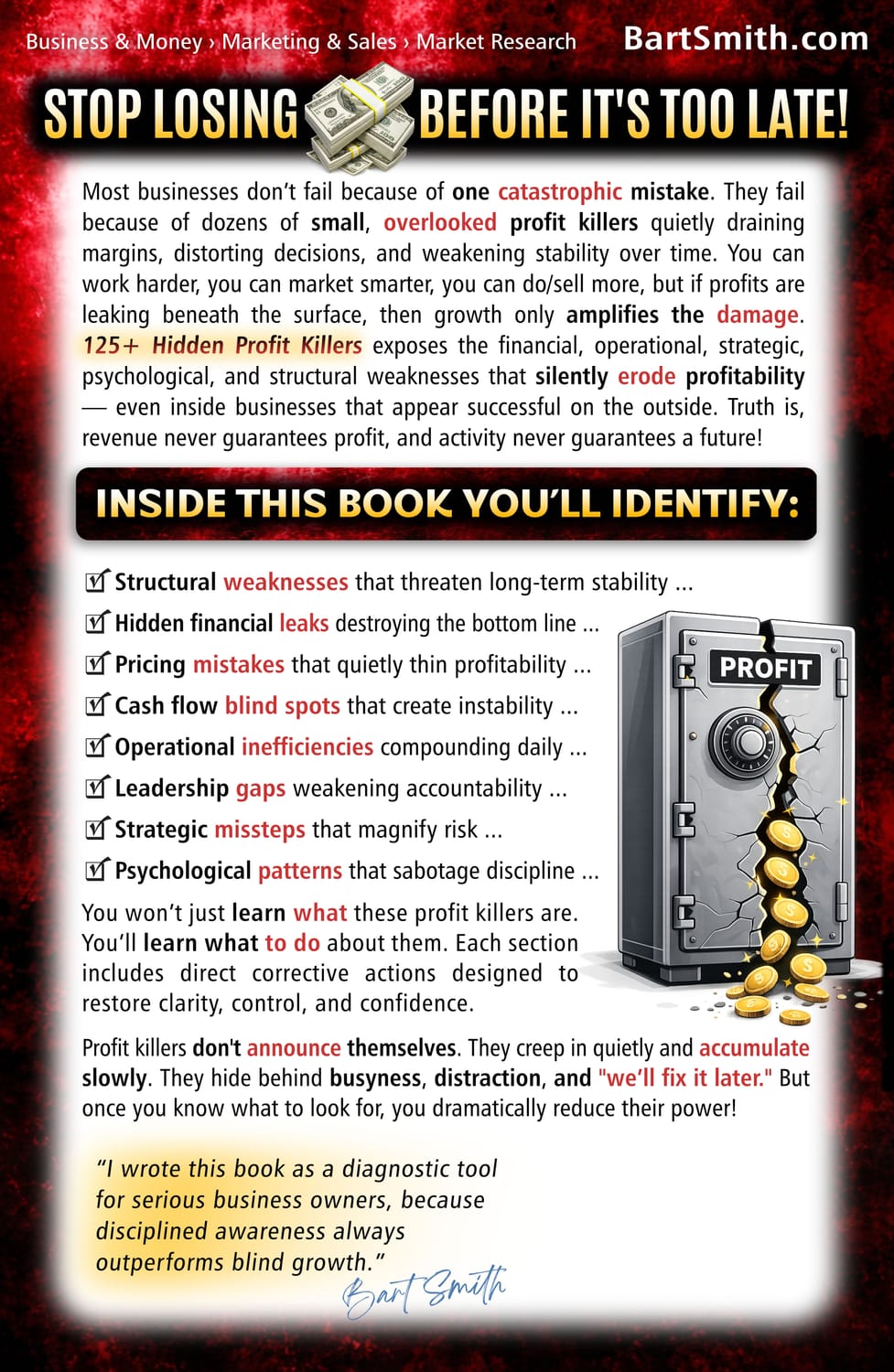
Excerpted and adapted from 125+ Hidden Profit Killers book by Bart Smith
Reprinted by Permission
A business can generate plenty of revenue and still struggle financially. Why? Because revenue is only part of the equation.
Weak pricing, sloppy billing, unnoticed expenses, poor cash-flow discipline, and shrinking margins can quietly eat away at the money your business works so hard to produce. As I explain in 125+ Hidden Profit Killers, financial problems often arrive quietly rather than dramatically.
Here are 20 financial profit killers every business owner should watch carefully.
1. Unbilled or underbilled work.
If the work gets completed but never makes it onto the invoice, you have performed work for free. Track completed work, audit invoices, and reconcile projects against billing.
2. Poor pricing strategy.
Underpricing damages margins. Constant discounting trains buyers to expect lower prices. Pricing should reflect your actual costs, positioning, value, and market conditions.
3. Scope creep without compensation.
Little favors and “quick changes” add up. Define project scope clearly and charge appropriately when that scope expands.
4. Delayed invoicing.
Waiting weeks to send an invoice means waiting weeks longer to get paid. Invoice immediately when milestones or projects are completed.
5. Weak accounts-receivable follow-up.
Money owed to you is not the same as money sitting in your bank account. Create a consistent system for reminders, overdue accounts, and collections.
6. Overstaffing relative to revenue.
Hiring faster than revenue grows can crush margins. Monitor payroll relative to sales and hire according to real demand.
7. Tolerating underperforming employees too long.
Poor performers affect productivity, morale, quality, and ultimately profit.
8. Inefficient workflow design.
Bad processes create delays, duplication, wasted labor, and unnecessary expense.

9. Lack of cost visibility.
When you cannot see where money is going, waste becomes difficult to identify. Break expenses into useful categories and review them consistently.
10. Failure to track KPIs.
Without meaningful numbers, management becomes guesswork. Identify a handful of key financial indicators and watch them regularly.
11. Not knowing your break-even point.
Revenue may look healthy while profitability remains fragile. Know how much revenue you must generate just to cover expenses.
12. Uncontrolled operating expenses.
Small recurring expenses can quietly become large annual drains. Review expenses line-by-line and eliminate low-return spending.
13. Mixing personal and business finances.
Blending the two makes performance harder to measure and can create accounting and tax problems.
14. Neglecting cash-flow forecasting.
Profit does not automatically mean liquidity. A rolling cash-flow forecast can help you anticipate shortages before they become emergencies.
15. Ignoring unit economics.
A product can sell well and still lose money. Know the profit generated by individual products, services, customers, and transactions.
16. Failing to monitor profit margins.
Growing sales while margins shrink can create the illusion of success. Track both gross and net margins.
17. Ineffective expense forecasting.
Unexpected costs are far less unexpected when you study historical spending and plan realistic buffers.
18. Lack of financial accountability.
Someone must own budgets, spending, and financial performance.
19. Ignoring the cost of capital.
Borrowed money has a price. Interest costs can turn mediocre investments into losing ones.
20. Failing to reinvest in profit-producing assets.
Taking every dollar out of the business can starve systems, technology, training, and assets that support future growth.
FINAL THOUGHT
The objective isn't to fix everything overnight. Pick the financial leaks hurting your business most, correct them, measure the improvement, and then move to the next one. Small leaks ignored become major losses. Small leaks corrected become stronger margins.
(THIS CONTINUES IN THE BOOK)
# # #
WOULD YOU LIKE TO:
RETURN TO THE:
WOULD YOU LIKE TO:

Website Design by Bart Smith
© Bart Smith | All Rights Reserved