BART SMITH OFFICIAL WEBSITE • AUTHOR • YOUTUBER • COOKIE BAKER • COOKBOOK CHEF • FUTURES TRADER



BOOK EXCERPT
📖 15 Ways To Get More Speaking Gigs
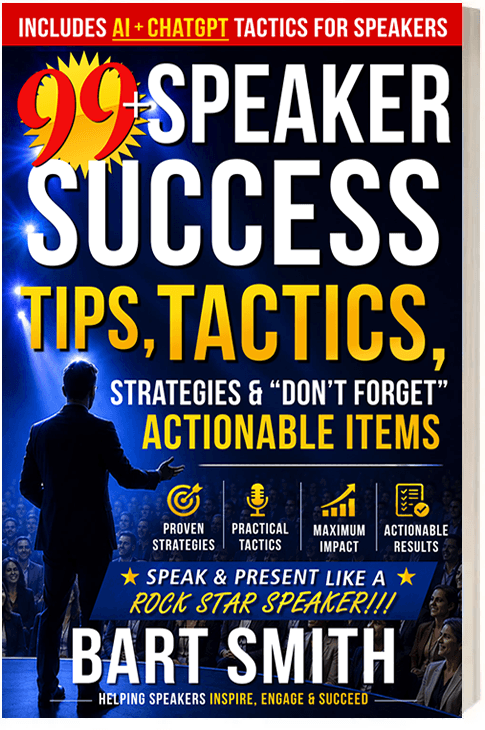
Excerpted and adapted from 99+ Speaker Success Tips book by Bart Smith
Reprinted by Permission
If you want more speaking gigs, waiting for the phone to ring is not a strategy.
Speaking opportunities are found, pitched, created, documented and multiplied. The more professional your speaker assets become and the more consistently you reach out, the more likely event planners, companies, associations and hosts are to discover and book you.
Here are 15 practical ways to create more speaking opportunities:
1. Build a clear speaker website or speaking page.
Make it easy for meeting planners to see who you are, what you speak about, what audiences learn and how to book you. Include strong photos, topic descriptions, testimonials, video clips, your bio and a clear booking button.
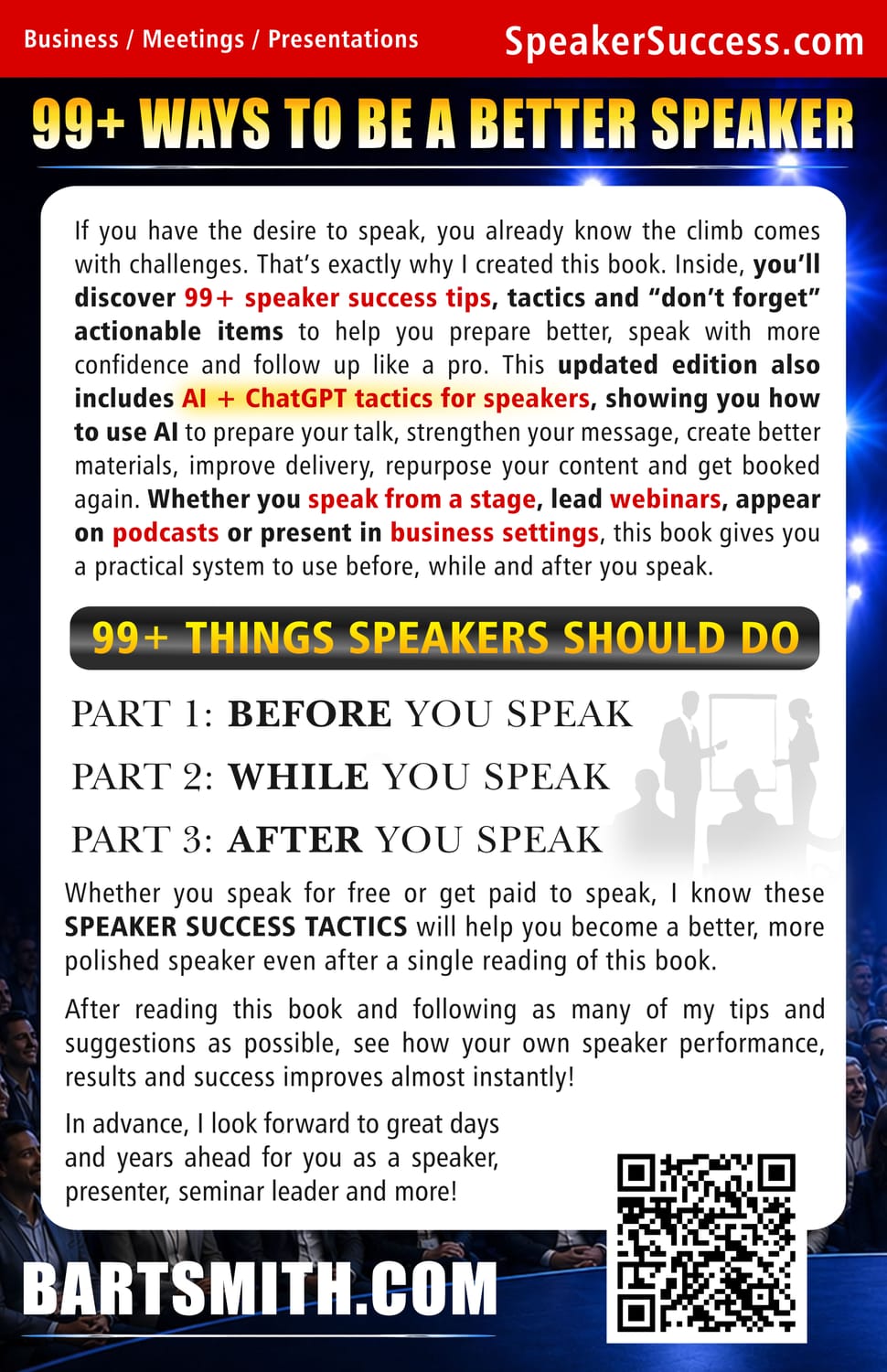
2. Create a professional speaker one-sheet.
A strong one-sheet gives organizers a fast overview of your topics, audience takeaways, credentials, presentation formats and contact information. Keep it current and visually polished.
3. Create several strong presentation topics.
Do not make planners guess what you could speak about. Develop a menu of clear, benefit-driven topics that solve recognizable problems for specific audiences.
4. Build versions of your talks for different lengths.
Have short, medium and long versions available. One host may need a 20-minute talk, another a 45-minute webinar, another a 90-minute keynote or a half-day training.
5. Search for speaking opportunities every week.
Look for associations, conferences, chambers of commerce, companies, schools, professional groups, podcasts, webinars, summits, retreats, MeetUp groups and networking organizations that need speakers.
6. Pitch organizers directly.
Write short, audience-focused outreach messages. Explain the problem your talk solves, what the audience will learn and why your topic fits their group.
7. Respond to calls for speakers and RFPs.
Many conferences and associations publicly request speaker applications. Read the requirements carefully and submit a clear proposal that uses the event's language and highlights audience value.
8. Research every organization before you pitch.
Study the event, host, audience, past speakers, theme, industry and current challenges. Customized pitches are much stronger than generic ones.
9. Create your own speaking opportunities.
If no one is booking you yet, host your own webinar, workshop, seminar, livestream, class, virtual summit or training session. Record it, photograph it and use it as proof.
10. Network with other speakers.
Speakers hear about opportunities. Build real relationships, exchange leads, attend one another's events and refer work when one of you is unavailable or not the right fit.
11. Use your book, articles and videos as authority assets.
Books, articles, interviews, videos and training content prove that you know your subject. Event planners want to see that you have material worth putting in front of an audience.
12. Create sample speaking footage.
If you do not yet have live-stage footage, record a clean three-to-ten-minute sample presentation. Give planners a chance to see your delivery style and personality.
13. Collect photos, testimonials and proof from every event.
Every speaking engagement should strengthen your future marketing. Save stage photos, audience shots, testimonials, host comments and short clips for your website and one-sheet.
14. Ask hosts and audience members for referrals.
After a successful presentation, ask whether they know another company, association, mastermind, chamber, school, podcast or conference that could benefit from the same topic.
15. Treat every speaking gig as a stepping stone to the next one.
Do not view presentations as isolated events. Use each one to improve your materials, build credibility, create content, collect proof and generate the next booking.
FINAL THOUGHT
More speaking gigs usually come from more consistent action: more research, more outreach, stronger assets, better proof and better follow-up.
Find the opportunities. Create the opportunities. Document the opportunities. Then use each one to get the next one.
(THIS CONTINUES IN THE BOOK)
# # #
WOULD YOU LIKE TO:
RETURN TO THE:
WOULD YOU LIKE TO:

Website Design by Bart Smith
© Bart Smith | All Rights Reserved