BART SMITH OFFICIAL WEBSITE • AUTHOR • YOUTUBER • COOKIE BAKER • COOKBOOK CHEF • FUTURES TRADER



BOOK EXCERPT
📖 15 Operational Profit Killers Costing Your Business Money
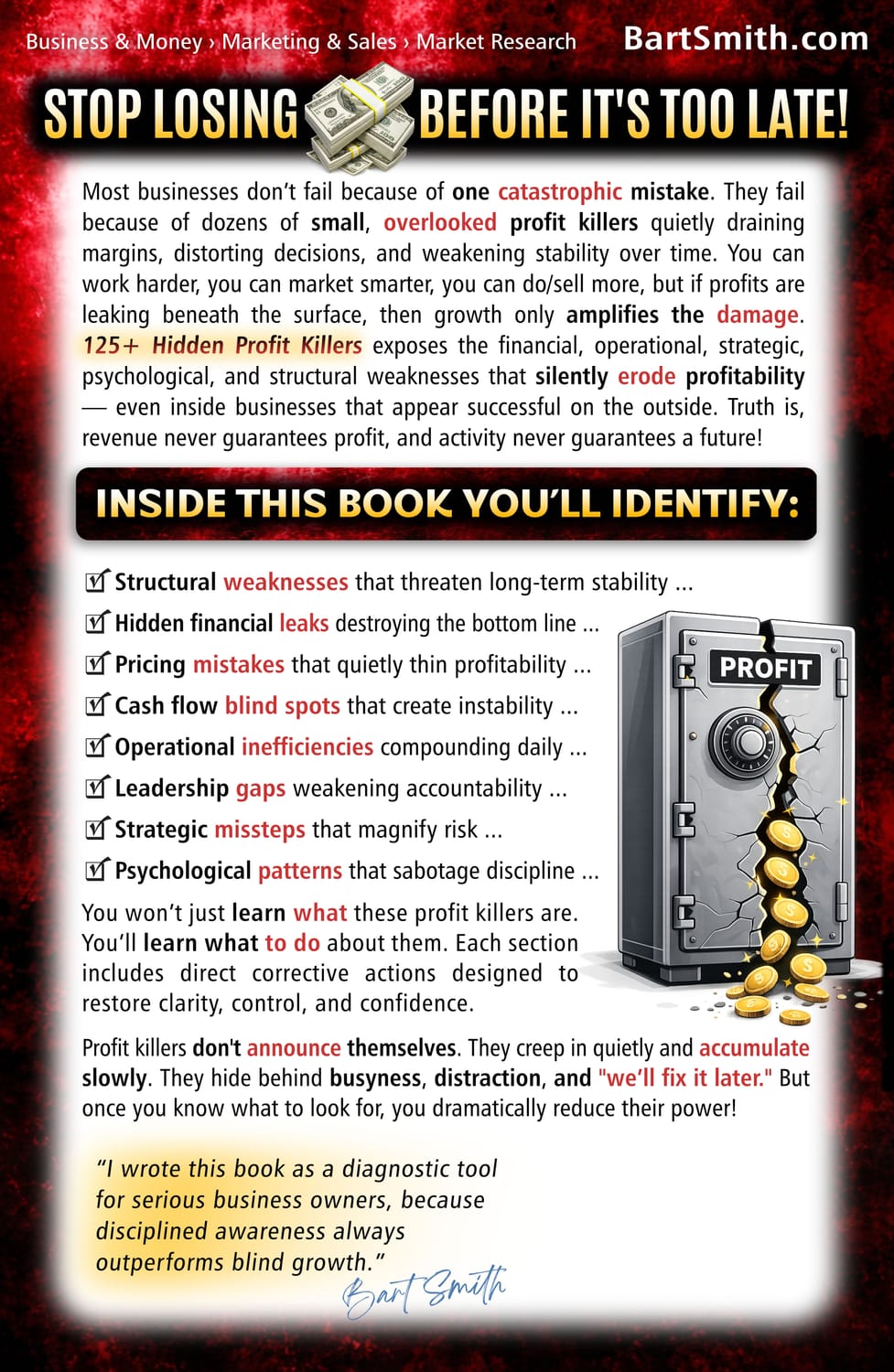
Excerpted and adapted from 125+ Hidden Profit Killers book by Bart Smith
Reprinted by Permission
Some businesses don't lose money because they lack customers. They lose money because everyday operations are inefficient.
A slow process here. Duplicate work there. Too many meetings. Manual tasks that could be automated. Poor communication. Errors that need to be corrected again and again.
None of these problems may look catastrophic individually. But operational friction increases costs, consumes labor, slows execution, and reduces the amount of productive work the business can accomplish.
Here are 15 operational profit killers worth investigating.
1. Inefficient workflow processes.
Map important workflows and look for bottlenecks, unnecessary handoffs, duplicated steps, and delays.
2. Lack of standard operating procedures.
When processes live inside someone's memory instead of a documented system, mistakes and inconsistency increase.
3. Poor time management across teams.
Payroll becomes expensive when valuable hours are consumed by low-priority activities, unnecessary meetings, and unclear priorities.
4. Excessive rework and error correction.
Doing something twice costs more than doing it correctly once. Track recurring errors and address their root causes.
5. Overstaffing relative to revenue.
Staffing should grow because workload and revenue justify it — not because expansion feels exciting.
6. Poor delegation.
When owners and managers hold onto too much work, they become bottlenecks. Give people clear outcomes, authority, and checkpoints.
7. Lack of process automation.
Repeated manual tasks consume labor and create opportunities for error. Automate high-frequency work whenever the economics make sense.
8. Weak internal communication.
Miscommunication creates duplication, missed deadlines, confusion, and mistakes.
9. Unclear role definitions.
When nobody knows exactly who owns a responsibility, tasks either get duplicated or forgotten.
10. Failure to measure operational efficiency.
What isn't measured often remains hidden. Track a few meaningful operational KPIs.
11. A reactive firefighting culture.
Businesses that spend every day putting out emergencies rarely have time to improve the systems creating those emergencies.
12. Uncontrolled scope expansion.
When projects continuously grow without additional compensation or capacity planning, margins get squeezed.
13. Manual data-entry errors.
Repeatedly entering the same information into multiple systems wastes time and increases mistakes.
14. Inefficient vendor coordination.
Poor supplier communication can create delays, inventory problems, downtime, and unexpected expense.
15. Scaling before your systems are ready.
Growth magnifies weaknesses. If your systems are already strained, more customers may create more chaos rather than more profit.

FINAL THOUGHT
Operational improvement doesn't necessarily mean working harder. Frequently, it means removing the friction that makes everyone work harder than necessary.
Fix the process.
Clarify responsibility.
Document the system.
Automate repetition.
Measure performance.
Then let your business produce more output from the resources you already have.
(THIS CONTINUES IN THE BOOK)
# # #
WOULD YOU LIKE TO:
RETURN TO THE:
WOULD YOU LIKE TO:

Website Design by Bart Smith
© Bart Smith | All Rights Reserved